Approved Use

Repatha® is an injectable prescription medicine used:

  • to reduce the risk of major adverse cardiovascular (CV) events, READ MOREsuch as death from cardiovascular disease, heart attack, stroke, certain types of chest pain conditions (unstable angina) requiring hospitalization, or certain types of heart surgery, in adults at increased risk for these events.
  • to reduce the risk of major adverse cardiovascular (CV) events, such as death from cardiovascular disease, heart attack, stroke, certain types of chest pain conditions (unstable angina) requiring hospitalization, or certain types of heart surgery, in adults at increased risk for these events.
  • Along with diet and exercise to reduce low-density lipoprotein (LDL) or bad cholesterol in adults with high blood cholesterol levels called hypercholesterolemia and in adults with a type of high cholesterol called heterozygous familial hypercholesterolemia (HeFH).

Repatha® is an injectable prescription medicine used:

  • to reduce the risk of major adverse READ MORE cardiovascular (CV) events, such as death from cardiovascular disease, heart attack, stroke, certain types of chest pain conditions (unstable angina) requiring hospitalization, or certain types of heart surgery, in adults at increased risk for these events.
  • Along with diet and exercise to reduce low-density lipoprotein (LDL) or bad cholesterol in adults with high blood cholesterol levels called hypercholesterolemia and in adults with a type of high cholesterol called heterozygous familial hypercholesterolemia (HeFH).

For adults with increased risk of a major cardiovascular event

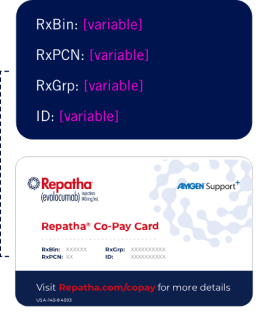
You are now enrolled based on your selected insurance type.

To use your co-pay card, follow these 3 simple steps

Print, Screenshot or save co-pay card information shown on this page or in your confirmation email
Share your co-pay card Information with your pharmacist
Pick up your Repatha® prescription

This is your personal co-pay card information:

Further verification will be completed at the time the card is used to confirm that you are an eligible commercially insured patient.

High LDL-C can lead to plaque buildup in your arteries, putting you at risk of a heart attack or stroke. Even if you’re making lifestyle changes or taking a statin, you may still be struggling to lower your LDL‑C.

spiral

Repatha® is a non-statin treatment.

Both statins and Repatha® help lower LDL-C, but they work differently. 

Statins help the liver produce less cholesterol and increase the liver's ability to reduce the LDL-C that's in your blood.  

Repatha® can help the liver lower the amount of LDL-C in your blood by inhibiting a protein called PCSK9.

Watch this video to see how.

  • TRANSCRIPT

    Meet Steven. Some people struggle with lowering their LDL, also known as “bad cholesterol”—including Steven. They eat well, take a statin for their cholesterol, but still aren’t getting where they need to be. Many factors affect our LDL level. Some of these we can change, like diet, physical activity, and weight. Others, we can’t—like family history. And since high LDL has no symptoms, many people don’t even know they have it. Sometimes our LDL levels can get too high—even if we eat well, take a statin, and stay physically active. What gives?

    If LDL gets too high, it can build up in the walls of your arteries and form plaque and cause hardening of the arteries—also known as atherosclerosis, which can lead to heart or blood vessel problems. So how do our bodies control the amount of LDL in our blood? LDL receptors in our liver. These receptors help keep our LDL levels in check by helping the liver remove LDL from the bloodstream before returning to remove even more. Make sense? The story doesn’t end there. The liver makes a protein called PCSK9 that is also involved in how much LDL is in our blood. PCSK9 attaches to the LDL receptors, telling the liver to get rid of the LDL receptor. However, this may cause a problem. Without enough receptors in the liver, our LDL numbers can get too high. But here’s some good news: There’s a medication that can limit the actions of PCSK9 and help dramatically lower cholesterol.

    What is Repatha®? Repatha® is an injectable prescription medicine used to reduce the risk of major adverse cardiovascular (CV) events, such as death from cardiovascular disease, heart attack, stroke, certain types of chest pain conditions (unstable angina) requiring hospitalization, or certain types of heart surgery, in adults at increased risk for these events. Along with diet and exercise to reduce low-density lipoprotein (LDL) or bad cholesterol in adults with high blood cholesterol levels called hypercholesterolemia and in adults with a type of high cholesterol called heterozygous familial hypercholesterolemia (HeFH).

    Do not use Repatha® if you are allergic to evolocumab or to any of the ingredients in Repatha®. Repatha® works differently than a statin. Statins help to stop your liver from making as much cholesterol, including LDL. Plus, they increase the liver’s ability to break down the cholesterol that’s already in your blood. But for some, a statin may not be enough. When Repatha® enters the liver, it keeps PCSK9 from breaking down too many LDL receptors. As a result, more receptors can return to remove additional LDL. And the more receptors you have, the lower your LDL cholesterol level will be. Repatha®, in addition to a statin, helps people like Steven who have heart disease drive LDL way down, to reduce the risk of heart attack and stroke. Get on the path to dramatically lower LDL. Talk to your doctor about Repatha® today.

    IMPORTANT SAFETY INFORMATION

    Do not use Repatha® if you are allergic to evolocumab or to any of the ingredients in Repatha®.

    Before you start using Repatha®, tell your healthcare provider about all your medical conditions, including if you are allergic to rubber or latex, are pregnant or plan to become pregnant, or are breastfeeding or plan to breastfeed. Repatha® is available as prefilled single-dose SureClick® autoinjectors and prefilled single-dose syringes that either contain dry natural rubber (a derivative of latex) in the needle cover or are not made with natural rubber latex. The carton and “Instructions for Use” will state if your prefilled single-dose SureClick® autoinjector or prefilled single-dose syringe contains dry natural rubber. The single-dose Pushtronex® system (on-body infusor with prefilled cartridge) is not made with natural rubber latex. Tell your healthcare provider or pharmacist about any prescription and over-the-counter medicines, vitamins, or herbal supplements you take.

    What are the possible side effects of Repatha®?

    Repatha® can cause serious side effects including, serious allergic reactions. Stop taking Repatha® and call your healthcare provider or seek emergency help right away if you have any of these symptoms: trouble breathing or swallowing, raised bumps (hives), rash or itching, swelling of the face, lips, tongue, throat or arms.

    The most common side effects of Repatha® include: runny nose, sore throat, symptoms of the common cold, flu or flu-like symptoms, back pain, high blood sugar levels (diabetes) and redness, pain, or bruising at the injection site. Tell your healthcare provider if you have any side effect that bothers you or that does not go away. These are not all the possible side effects of Repatha®. Ask your healthcare provider or pharmacist for more information. Call your healthcare provider for medical advice about side effects.

    You are encouraged to report negative side effects of prescription drugs to the FDA. Visit www.fda.gov/medwatch, or call 1-800-FDA-1088.

    Please see full Prescribing Information, including Patient Product Information.

    Ask your doctor if Repatha® is right for you.

Repatha® works to quickly reduce LDL-C in

99.5%

of patients

Repatha® can help get you below goal

Repatha® drops LDL-C. By how much?

Important Safety Information

Do not use Repatha® if you are allergic to evolocumab or to any of the ingredients in Repatha®.

Before you start using Repatha®, tell your healthcare provider about all your medical conditions, including if you are allergic to rubber or latex, are pregnant or plan to become pregnant, or are breastfeeding or plan to breastfeed. Repatha® is available as prefilled single-dose SureClick® autoinjectors and prefilled single-dose syringes that either contain dry natural rubber (a derivative of latex) in the needle cover or are not made with natural rubber latex. The carton and “Instructions for Use" in the carton will state if your prefilled single-dose SureClick® autoinjector or prefilled single-dose syringe contains dry natural rubber. The single-dose Pushtronex® system (on-body infusor with prefilled cartridge) is not made with natural rubber latex.

Tell your healthcare provider or pharmacist about any prescription and over-the-counter medicines, vitamins, or herbal supplements you take.

What are the possible side effects of Repatha®?

Repatha® can cause serious side effects including serious allergic reactions. Stop taking Repatha® and call your healthcare provider or seek emergency help right away if you have any of these symptoms: trouble breathing or swallowing, raised bumps (hives), rash or itching, swelling of the face, lips, tongue, throat or arms.

The most common side effects of Repatha® include: runny nose, sore throat, symptoms of the common cold, flu or flu-like symptoms, back pain, high blood sugar levels (diabetes) and redness, pain, or bruising at the injection site.

Tell your healthcare provider if you have any side effect that bothers you or that does not go away.

These are not all the possible side effects of Repatha®. Ask your healthcare provider or pharmacist for more information. Call your healthcare provider for medical advice about side effects.

You are encouraged to report negative side effects of prescription drugs to the FDA. Visit www.fda.gov/medwatch, or call 1-800-FDA-1088.

APPROVED USE

What is Repatha®?

Repatha® is an injectable prescription medicine used:

  • to reduce the risk of major adverse cardiovascular (CV) events, such as death from cardiovascular disease, heart attack, stroke, certain types of chest pain conditions (unstable angina) requiring hospitalization, or certain types of heart surgery, in adults at increased risk for these events.
  • Along with diet and exercise to reduce low-density lipoprotein (LDL) or bad cholesterol in adults with high blood cholesterol levels called hypercholesterolemia and in adults with a type of high cholesterol called heterozygous familial hypercholesterolemia (HeFH).

Please see full Prescribing Information, including Patient Product Information.